After 30 years of writing the saga of horse racing in Ontario during the turbulent 1960s, Hot-Walker Life on the Fast Track is now available online.
Charting the years and relationships of four Toronto high school friends and an American draft-dodger, Frannie Harrison recounts her life when living in Yorkville Village, racing thoroughbreds and the violent murder of her fiance at Woodbine Racetrack. Enduring eight years of waiting, she returns from living in London as the key-witness in the scandalous trial that reveals the shocking truth. Hot-Walker, an international saga on horse racing, romance, drugs, murder and courtroom drama.
The saga of Hot-Walker; following the life of Francine Harrison during her years of racing thoroughbreds, living in Yorkville, Montreal, London, and then returning to Toronto where the murder trial of her fiance, an American draft dodger brutally killed at Woodbine racetrack, 1969, is being held. As the only witness to the horrific incident, Francine struggles with relationships during the years awaiting trial, hopelessly making an effort to move on with her life, until the mystery unwinds in 1977 at the Court House...
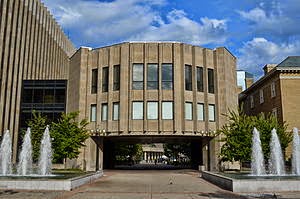
During the years when Francine and her friends lived in Yorkville Village, the first phase of the complex, Toronto Courthouse, (Completed by Toronto firm of Marani, Rounthwaite and Dick Architects) was opened (1966) at 361 University Avenue and the corner of Armoury Street. It was originally known as Metropolitan Toronto Courthouse. Additions to the structure were completed with the South Wing (1985) and a two storey addition to the courthouse (1987).
The project architect, Ronald A. Dick noted it as an important example of late 20th century Modern design, the largest of its type built in Ontario ... featuring an eight-storey complex for courtrooms and offices connected to the three-storey South Wing. This features a 12-sided plan with an open passageway in the lower level. Covered by a copper-clad roof, the structure is faced with limestone.
The north and south elevations feature fin walls that organize the horizontal grid of metal-framed window openings and limestone spandrels with beveled edges. The courthouse structure was among the last complexes in the province clad with local limestone. Amongst the landscaping, planter boxes, flagpoles and shallow pools with fountains, you would find limestone benches.
But ... there is a hidden ancient mystery held in the construction of such 'temples' as those within secret societies were aware of, which is limestone is calcite that is formed by rainwater filtered through sand; a sedimentary stone and holds basic properties essential to life, namely the attribute of attracting atmospheric water vapour, condensing it into water, and then letting it pass out into streams and springs. Limestone works like a crystal; it is in constant motion emitting a vibrational frequency that amplifies the energy of the surrounding area and matches the electromagnetic field of the Earth and its human occupants. It also has the crystalline property to absorb, store, and transfer life-force energy. Limestone was used for construction because of these crystalline properties ... which are those of resonance, rhythm and vibration ... it is alive, holding the memory of information and like crystals, healing vibrations. Hot-Walker, Life on the Fast Track Book Trailerfor your viewing.
Women
Jockeys in Canadian Racing Hot-Walker, the sports-crime novel, explores the ins-and-outs of
thoroughbred racing, including the introduction of Karen Sharp, woman jockey. A
novel about life on the fast track during
the 1960s, and the relationships of those
living in Yorkville and working on the racetrack.
Looking back over the years when racing experienced a time
of introspection and growth, Jockeys' rooms at virtually every racetrack were
described as dark, dingy, overcrowded, lacking in recreational areas, without
proper reducing facilities, no eating and resting spaces, and very little room
to move about and work. The jockeys' rooms were not a priority to management
but the Jockeys' Guild and its representatives set about a campaign to improve
conditions both on and off the track. Jockeys still had very few rights when dealing with stewards. If a steward did not like a rider's looks, they could, and often did, tell that rider to go somewhere else to ride. There was still widespread abuse of a jockey's rights to work his trade.
The
popular ‘big names’ and leading riders of the 1940s were Adams, Arcaro, Atkinson,
Meade and Longden, who continued to dominate in the early 1950s but were joined by a
new name; Shoemaker. After completing his sophomore year of racing with 388
victories, good for a tie in the leading rider standings, Shoemaker topped all
riders in earnings in 1950 with over $ I-million.
Another fact to be reckoned
with for jockeys was women entering their ranks. Although women jockeys were barred from riding at
registered race meetings, in the mid-1900s, Wilhemena Smith rode as Bill Smith
at northQueenslandracecourses. She was nicknamed BillGirlieSmith because she arrived on course
with her riding gear on under her clothes and did not shower on course. It was
only at the time of her death in 1975 that the racing world was officially told
that Bill was really Wilhemena. Subsequent inquiries revealed that William
Smith was actually a woman who had been born Wilhemena Smith in a Sydney
hospital in 1886.In an era when
women were clearly denied equality, she had become known as a successful jockey
in Queensland country districts as 'Bill Smith'.
Themodern
era of female jockeysbegan
as Kathy Kusnersuccessfully sued the Maryland Racing Commission for a
jockey's license in 1968 under the Civil Rights Act. In late 1968, Penny Ann Earlybecame
the first licensed female thoroughbred jockey in the US, and entered three
races at Churchill Downs in
November, but the male jockeys announced that they would boycott those races.
On February 7, 1969, Diane Crumpwas
the first female rider to ride in a Thoroughbred race in the United States at
theHialeah Park Race Trackin Florida.She made
history again, the next year, when she became the first female jockey to ride
in the Kentucky Derby, finishing 15th aboard Fathom. Even though the male
jockeys fought the presence of females in the irons, the barrier had been
broken. Two weeks later on February 22 atCharles TowninWest Virginia,Barbara Jo Rubinbecame the first woman to win a race and went on to
win 11 of her first 22.Others
soon followed suit and over the years American women jockeys have proven their
ability.Julie Krone has the most winning races by an American woman.
Jockeys must be light to ride at
the weights which are assigned to their mounts. There are horse carrying weight
limits, that are set by racing authorities. The Kentucky Derby, for example,
has a weight limit of 126 lb (57 kg) including the jockey's
equipment. The weight of a jockey usually ranges from
108 to 118 lb (49 to 54 kg).Despite their light weight, they must be able to control a horse that is
moving at 40 mph (64 km/h) or more, and weighs 1,200 lbs (540 kg).Though there is no
height restrictions for jockeys, they are usually fairly short due to the weight
limits. Jockeys typically stand around 4 ft 10 in (1.47 m)
to 5 ft 6 in (1.6m).
For the most part
Canada has generally followed the U.S.'s lead in the area of opportunities
for female riders. Canada has far fewer tracks than the U.S. and has only two
female jockeys with 1,000 wins. However, in both actual and relative numbers as
well as overall success rate, Canada has
far surpassed its southern neighbour in opportunities for women at the
highest level; namely their respectiveTriple Crown series.
Starting withJoan Phippsin the Canadian 1973Breeders'
Stakes, 9 different women have competed in 27Canadian Triple Crownraces, 34 times with a combined 2
wins, 3 places, 3 shows. By comparison, sinceDiane Crumprode in the 1970Kentucky
Derby,only 6
different women have competed in 18 totalU.S. Triple
Crownevents with a
combined record of 1 win, 1 place, 1 shows. Moreover, while no US Triple Crown
race has ever featured more than one female rider, that feat has occurred on 7
occasions in Canada. Most impressively, 3 different women - Francine Villeneuve,Chantal Sutherlandand Emma-Jayne
Wilson(twice over) -
have each raced in all three of the Canadian Triple Crown races. Women Jockeys in Canada are supreme riders!
Hot-Walker, Life on the Fast Track(youtube) Book Trailer ... ebook coming soon .
Hot~Walker begins its racetrack ventures in 1965 at Greenwood Racetrack, a horse racing facility in Toronto, inaugurated in 1874 as Woodbine Race Course at the foot of Woodbine Avenue and Lake Ontario. The novel tells the story of the murder trial of Francine Harrison's fiance, an American draft dodger, John Mencini who trained thoroughbreds.
Racing has had a long history in the Toronto area. In the early 1880s, Duggan founded the Ontario Jockey Club (OJC). Thoroughbred racing continued at Old Woodbine on a shortened six furlong (1,207 m) track and Harness races were conducted on the thoroughbred track, but serious problems with mud (including the starting gate being immobilized) led to the construction of a five-furlong (1006 m) stone dust harness track inside the thoroughbred track. This track was known for its tight turns and long back and homestretches.
In the early 1950s, the Ontario Jockey Club, led by directors E. P. Taylor, George C. Hendrie and J. E. Frowde Seagram, undertook an acquisition and consolidation program for southern Ontario racing. By 1956, the OJC operated a new facility for Thoroughbred horse races, which was constructed in Toronto suburbs, and given the name New Woodbine Racetrack. This was the location and setting for the racehorse, SnoMann, and his big win in 1969,
The Old Woodbine facility was completely renovated and renamed Greenwood Raceway in 1963. It held both harness racing and thoroughbred racing meets until its closure at the end of 1993. Steeplechase races were held at Woodbine/Greenwood for a few years.
In 1994, the thoroughbred and harness operations were moved to Woodbine. The stadium was demolished and replaced by residential and commercial development, including a betting parlour. Half of the property became Woodbine Park. It is the only horseracing track in North America which stages, or is capable of staging,thoroughbred and standardbredhorseracingprograms on the same day.
Mallory Neeve Wilkins Novel Hot-Walker Life on the Fast Track
This Canadian horse racing story was the original novel, SnoMann, that I wrote in the 1980s. The manuscript was gathering dust as it grew from the IBM typewriter to floppy disc to CD and finally reedited and pulled together some 30 years later ... feeling safe that the information was not as dangerous today as it once was ... back in the day.
We meet many individuals along our journey, some gifted while others are, well, different. We all have a story and in Hot~Walker, I released a lot of the struggles and hardships from my youth. It is quite remarkable how writing can save a life, encourage employment, tell a story, make people laugh and heal over time, make beautiful music and produce great screenplays. Yes, the script of letting-go can definitely bring enjoyment, and reading has to be one of the best pastimes to keep the brain sharp and functioning. Novels Available Online




.jpg "Mallory Neeve Wilkins Novels")
.png)
