The saga of Hot-Walker; following the life of Francine Harrison during her years of racing thoroughbreds, living in Yorkville, Montreal, London, and then returning to Toronto where the murder trial of her fiance, an American draft dodger brutally killed at Woodbine racetrack, 1969, is being held. As the only witness to the horrific incident, Francine struggles with relationships during the years awaiting trial, hopelessly making an effort to move on with her life, until the mystery unwinds in 1977 at the Court House...
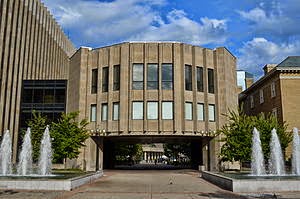
During the years when Francine and her friends lived in Yorkville Village, the first phase of the complex, Toronto Courthouse, (Completed by Toronto firm of Marani, Rounthwaite and Dick Architects) was opened (1966) at 361 University Avenue and the corner of Armoury Street. It was originally known as Metropolitan Toronto Courthouse. Additions to the structure were completed with the South Wing (1985) and a two storey addition to the courthouse (1987).
The project architect, Ronald A. Dick noted it as an important example of late 20th century Modern design, the largest of its type built in Ontario ... featuring an eight-storey complex for courtrooms and offices connected to the three-storey South Wing. This features a 12-sided plan with an open passageway in the lower level. Covered by a copper-clad roof, the structure is faced with limestone.
The north and south elevations feature fin walls that organize the horizontal grid of metal-framed window openings and limestone spandrels with beveled edges. The courthouse structure was among the last complexes in the province clad with local limestone. Amongst the landscaping, planter boxes, flagpoles and shallow pools with fountains, you would find limestone benches.
But ... there is a hidden ancient mystery held in the construction of such 'temples' as those within secret societies were aware of, which is limestone is calcite that is formed by rainwater filtered through sand; a sedimentary stone and holds basic properties essential to life, namely the attribute of attracting atmospheric water vapour, condensing it into water, and then letting it pass out into streams and springs. Limestone works like a crystal; it is in constant motion emitting a vibrational frequency that amplifies the energy of the surrounding area and matches the electromagnetic field of the Earth and its human occupants. It also has the crystalline property to absorb, store, and transfer life-force energy. Limestone was used for construction because of these crystalline properties ... which are those of resonance, rhythm and vibration ... it is alive, holding the memory of information and like crystals, healing vibrations. Hot-Walker, Life on the Fast Track Book Trailerfor your viewing.
Hot~Walker begins its racetrack ventures in 1965 at Greenwood Racetrack, a horse racing facility in Toronto, inaugurated in 1874 as Woodbine Race Course at the foot of Woodbine Avenue and Lake Ontario. The novel tells the story of the murder trial of Francine Harrison's fiance, an American draft dodger, John Mencini who trained thoroughbreds.
Racing has had a long history in the Toronto area. In the early 1880s, Duggan founded the Ontario Jockey Club (OJC). Thoroughbred racing continued at Old Woodbine on a shortened six furlong (1,207 m) track and Harness races were conducted on the thoroughbred track, but serious problems with mud (including the starting gate being immobilized) led to the construction of a five-furlong (1006 m) stone dust harness track inside the thoroughbred track. This track was known for its tight turns and long back and homestretches.
In the early 1950s, the Ontario Jockey Club, led by directors E. P. Taylor, George C. Hendrie and J. E. Frowde Seagram, undertook an acquisition and consolidation program for southern Ontario racing. By 1956, the OJC operated a new facility for Thoroughbred horse races, which was constructed in Toronto suburbs, and given the name New Woodbine Racetrack. This was the location and setting for the racehorse, SnoMann, and his big win in 1969,
The Old Woodbine facility was completely renovated and renamed Greenwood Raceway in 1963. It held both harness racing and thoroughbred racing meets until its closure at the end of 1993. Steeplechase races were held at Woodbine/Greenwood for a few years.
In 1994, the thoroughbred and harness operations were moved to Woodbine. The stadium was demolished and replaced by residential and commercial development, including a betting parlour. Half of the property became Woodbine Park. It is the only horseracing track in North America which stages, or is capable of staging,thoroughbred and standardbredhorseracingprograms on the same day.
The action packed novel, Hot~Walker is filled with secrets of the racing world. 1960s was a time when women made a statement, even riding on the racetrack. The female jockey made a change in thoroughbred training.
The novel Hot~Walker is set in Ontario and Quebec racetracks. The Montreal historic Blue Bonnets racetrack began in 1872 and was located in Ville Saint-Pierre. The Jockey Club of Montreal wasn't founded until 1905 by John F. Ryan and then the new Blue Bonnets Raceway was moved to a new location on Decarie Blvd in June, 1907 where racing lasted for many years.
The president in 1920 was JKL Ross, owner of Sir Barton, the first thoroughbred to win the USA triple crown. In 1932 the racetrack was sold and in 1943, harness racing came to Blue Bonnets and it was in 1954 when flat racing thoroughbreds ended.
In 1958, the racetrack was sold to JL Levesque who built a new multi-million dollar facility and brought back thoroughbred racing in 1961.Hot~Walker's years of racing took place during this time, and in 1965 Paul Desmarais, the CEO of Power Corporation of Canada took control for its remaining years. It all ended in 2009 and was later dismantled to make way for a housing project.
.jpg)